
Managing Competency Gaps Under SIRE 2.0: Transforming "Custom & Practice" Drift Into Proactive Growth Loops
Jul 9
A New Vetting Paradigm: Decoding the 37% Human Element Deficiency Baselines
In contemporary tanker operations, technical execution, hull integrity, and hardware-related safety standards have reached historically high baselines due to decades of stringent structural enforcement. However, global vetting metrics reveal a defining paradigm shift across the maritime sector: while structural findings and equipment-related deficiencies are steadily decreasing, human factor dynamics now account for approximately 37% of all negative vetting observations. Comprehensive industry reviews confirm that roughly 50% of maritime incidents are directly initiated by human error, with an additional 30% occurring due to the failure of personnel to proactively mitigate a developing risk before it escalates.
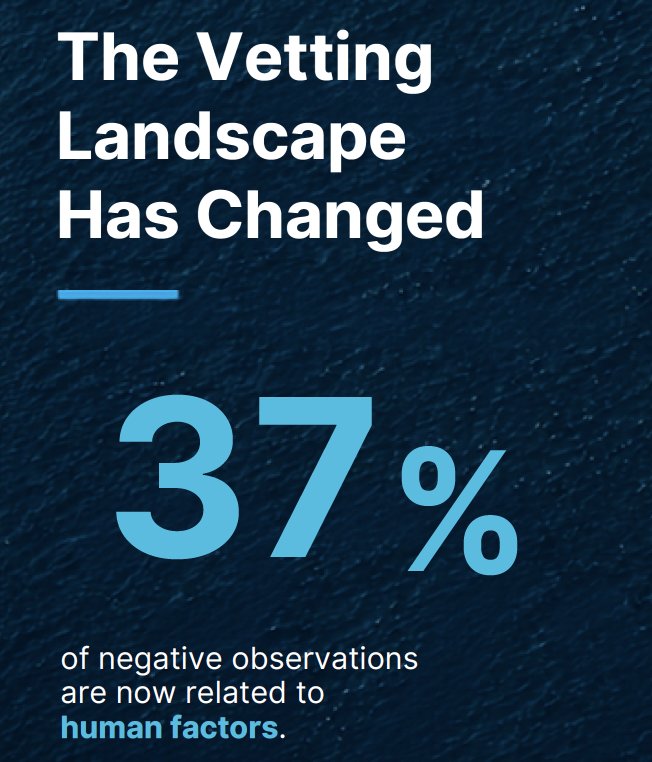
This compelling statistical reality does not imply a deficiency in seafarer capability or professionalism. Rather, it highlights a critical management vulnerability—the necessity of identifying and bridging the invisible "Competency Gaps" where everyday onboard execution (Custom & Practice) slowly drifts away from official Safety Management Systems (SMS). Under the mature SIRE 2.0 regime, vetting inspectors no longer merely audit static technical checklists; they evaluate how effectively companies support their crews by managing Performance Influencing Factors (PIF) and establishing an objective growth culture.
In demanding operational settings, mapping these invisible drifts and addressing them through transparent, supportive mechanisms has become a necessity for vessel operators. At Maritime Trainer, to turn these operational variances into objective, non-assertive, and reportable solutions, we examine the framework and methodology of our BOCAV (Behavioural & Operational Competency Assessment and Verification) module.
Anatomy of the Competency Gap: Merging Soft Skills with Technical Precision
Operational success in high-consequence shipboard environments goes far beyond theoretical checklist compliance. Executing a proper cargo valve line-up or warming through steam turbine cargo pumps requires absolute technical alignment; however, maintaining situational awareness under pressure, ensuring clear radio dialogue, and projecting future system states are strictly behavioural competencies. The BOCAV approach seamlessly unifies these two critical dimensions into a single digital matrix:
BOCAV Unified Matrix
BCAV Behavioural Domain
6 Core Behavioural Domains
ICMG Technical Domain
72 Rank-Specific Competencies
The Behavioural Domain
The behavioural appraisal infrastructure is founded on the established industry guidance found in global non-technical skill and verification guidelines administered by oil major associations. It assesses the 6 core behavioural domains essential for safety culture: teamwork, communication and influencing, situation awareness, decision making, results focus, and leadership and managerial skills. This data structure is systematically reinforced by objective positive and negative indicators defined across established international maritime frameworks, maximizing assessment objectivity.
The Technical Domain
To ensure behavioural observation stays anchored to real-world tasks, these non-technical markers are mapped directly against the rank-specific 72 critical technical competencies extracted from global competence management guidance frameworks. Consequently, an officer’s technical execution and behavioural response are validated simultaneously during critical operations.
The BOCAV Solution: Evidence-Based Verification and Assessor Mentoring
Traditional performance evaluation tools are static snapshots, heavily restricted by occasional shoreside superintendent visits and a box-ticking mentality. BOCAV replaces this stagnant approach with a continuous, dynamic verification network.
The framework conducts evidence-based gap analysis across 4 core operational areas: navigation, mooring, tanker cargo operations, and marine engineering. Managed through our structured observation methodology, the process relies on the following transparent verification parameters:
The framework conducts evidence-based gap analysis across 4 core operational areas: navigation, mooring, tanker cargo operations, and marine engineering. Managed through our structured observation methodology, the process relies on the following transparent verification parameters:
Navigation and Situational Awareness Verification:
Verification of passage planning execution, wheel-over execution, and restricted water ship-handling safety under clear operational criteria.
Mooring and Terminal Safety Verification:
Monitoring of tension limits, snap-back hazard awareness, and line management parameters during exposed jetty, SPM (Single Point Mooring), or underway STS operations.
Cargo Operations Safety Verification:
Auditing tank atmosphere logs, gas freeing, secondary venting tolerances, crude oil washing (COW) timelines, and noxious substance sampling protocols.
Marine Engineering Verification:
Operational analysis of machinery watchkeeping routines, steam plant preparation, auxiliary generator overhauls, and power management troubleshooting under pressure.
Multi-Dimensional 360 Evaluation Framework
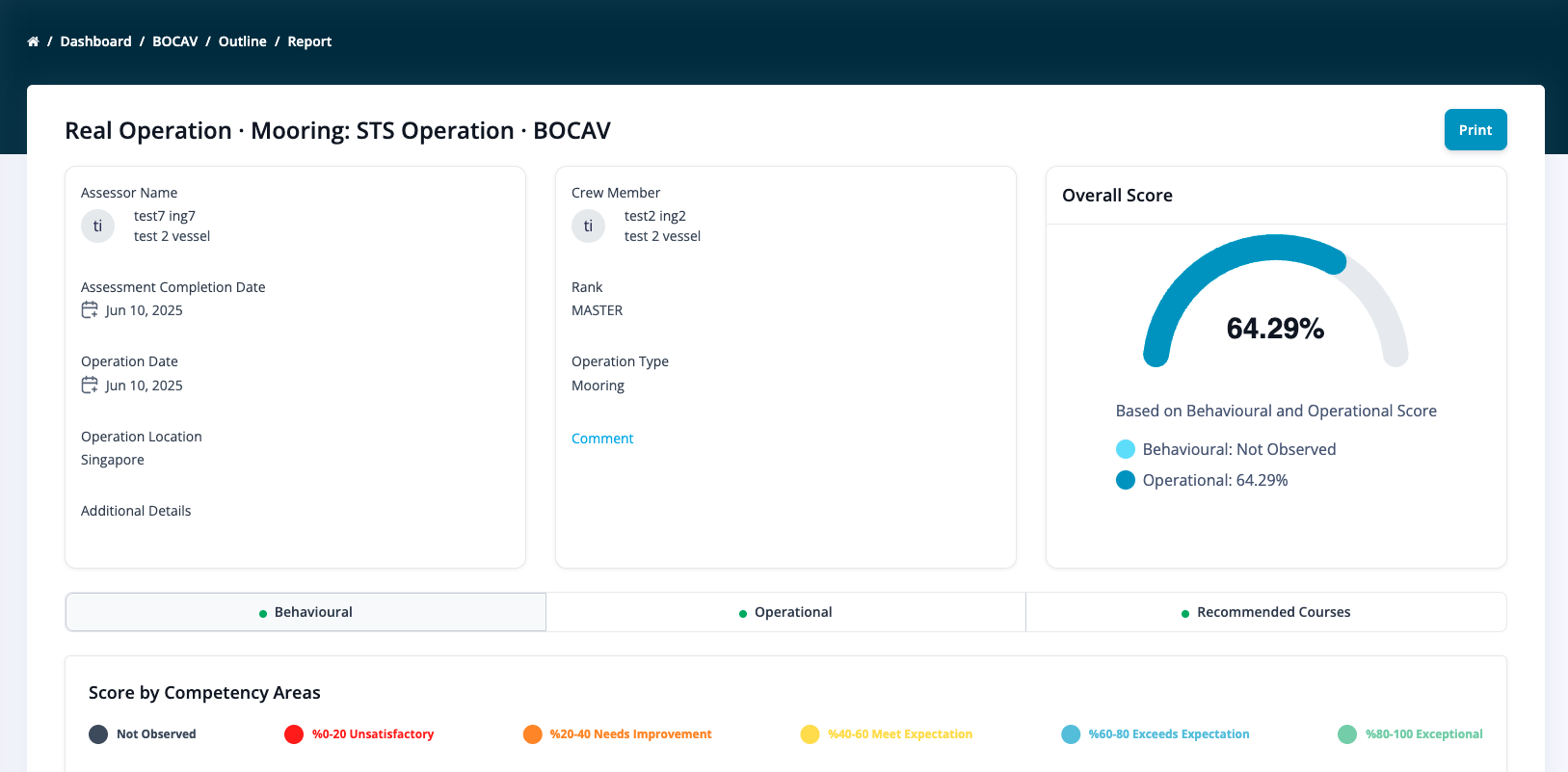
A multi-perspective feedback loop is managed directly over the platform, allowing an officer's performance to be validated by peers, managers, and subordinates. This multi-angled approach completely mitigates subjective bias, yielding a fair and transparent safety profile.
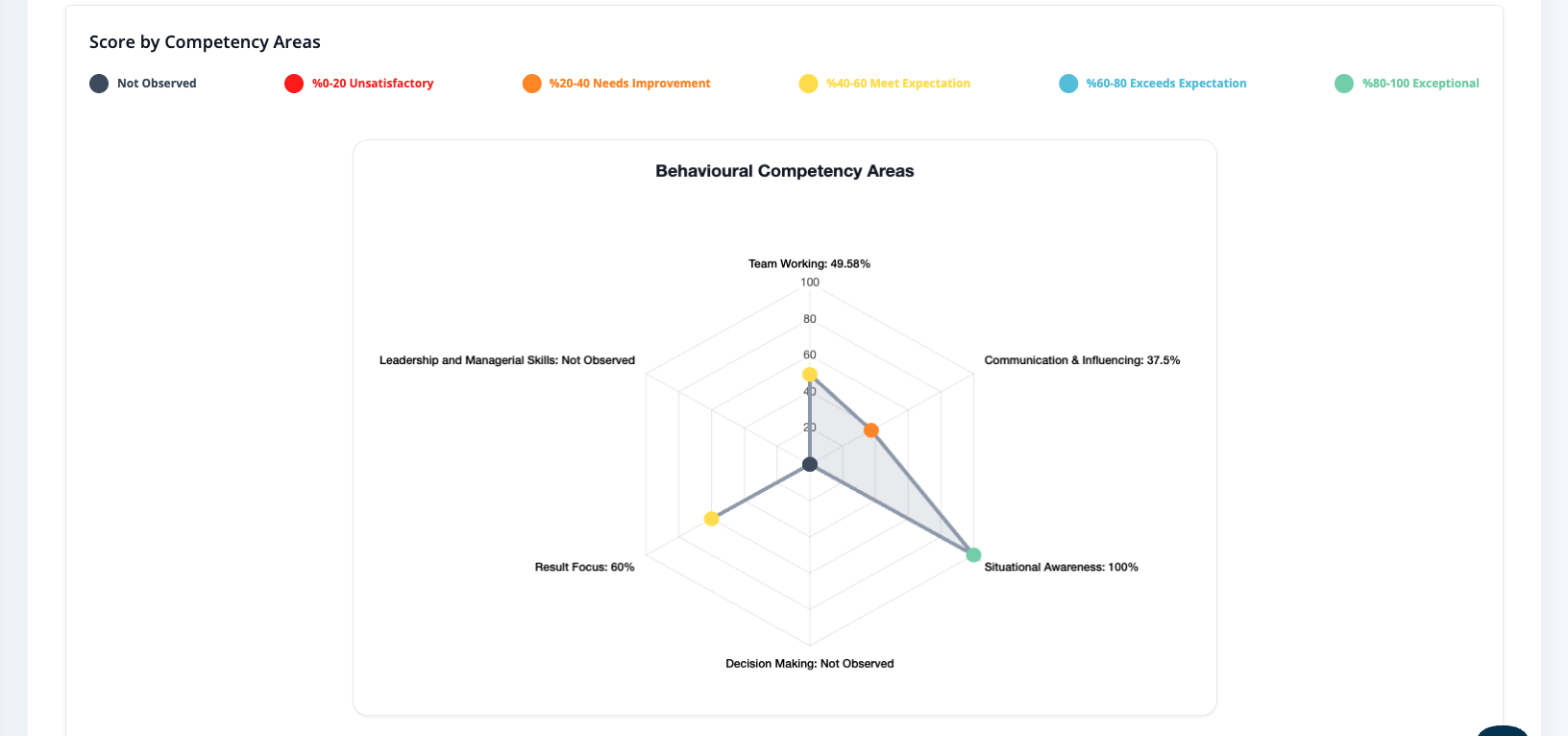
Assessor Interventions and Mentoring Architecture
BOCAV is a human-in-the-loop ecosystem that leverages the specialised expertise of your senior crew and shoreside superintendents (assessors). When an inspector or senior officer verifies a specific Custom & Practice drift, they can actively intervene via the platform—recommending target-specific practical training, structuring bespoke mentoring paths, leaving localized notes, and providing customized developmental suggestions
Achieving Training Automation
The speed at which a verified operational gap is resolved directly defines a vessel's risk profile. However, managing this closure without expanding the administrative overhead ashore or increasing crew fatigue onboard remains a significant challenge.
BOCAV solves this by integrating seamlessly with the architecture of global vocational competency frameworks to deliver total learning automation. The moment an operational loop or gap is verified during an assessment or a 360 review, the platform’s intelligence triggers immediately. Without causing manual shoreside lag, it automatically maps and assigns precise, rank-specific CBT (Computer-Based Training) modules directly to the seafarer's active dashboard.
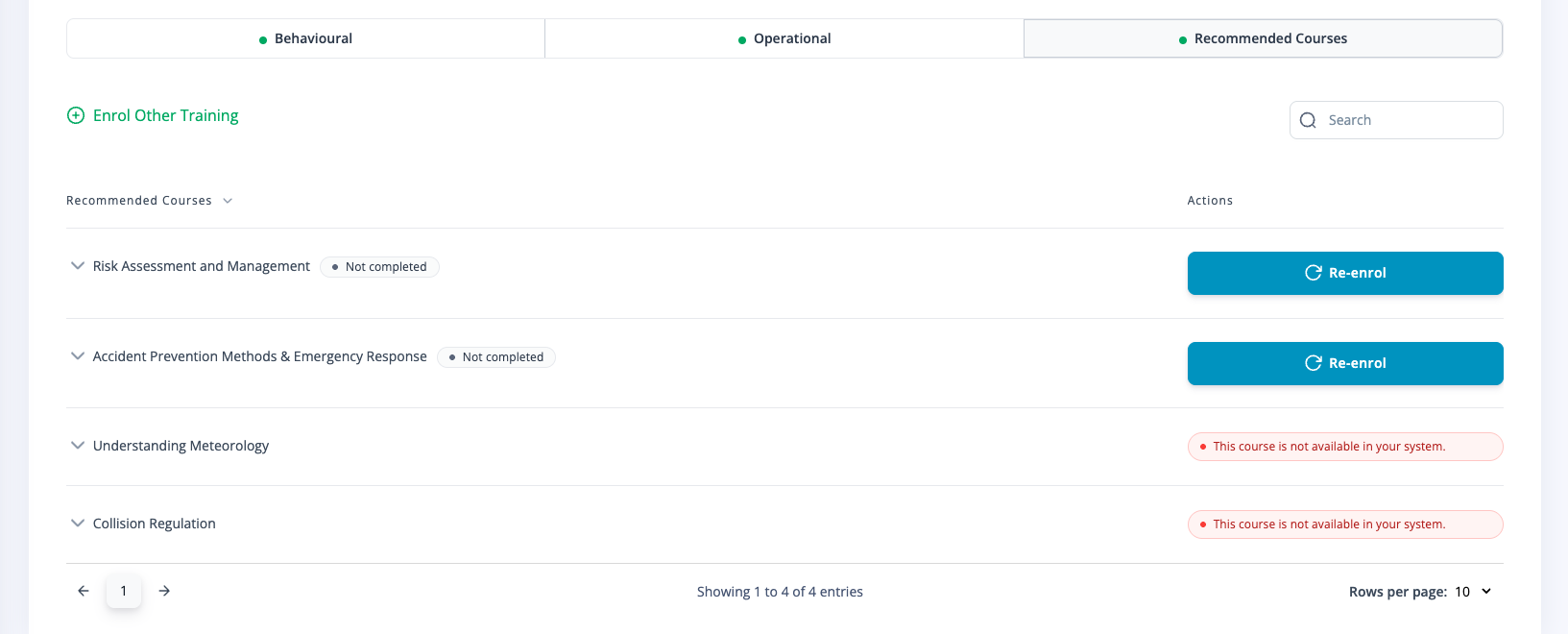
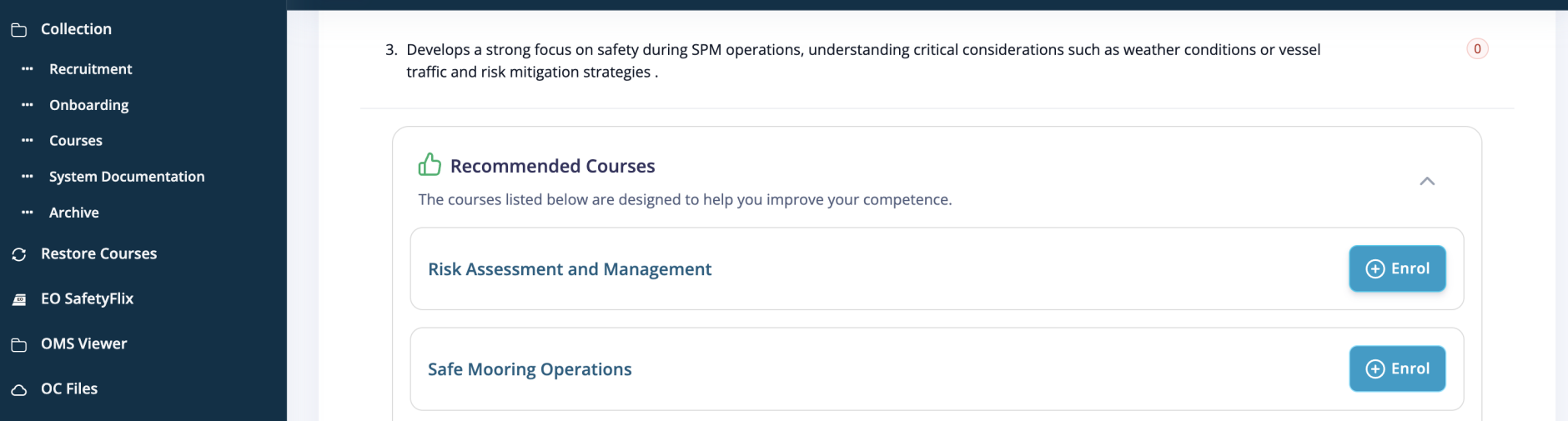
Detailed marine casualty investigations confirm that the root causes rarely stem from a simple lack of basic certificates. Instead, they trace back to failures in maintaining safety standards, lost situational awareness, or poor leadership execution. BOCAV's automated adjustment cycle continuously tracks core maritime leadership competencies, systematically mitigating high-consequence operational vulnerabilities. Providing clean, reportable metrics ensures that you can present irrefutable evidence of systematic safety maturity and continuous improvement to modern tanker operations.
Vetting Assurance Aligned With
SIRE 2.0 Expectations
Under the mature SIRE 2.0 vetting regime, long-term commercial success belongs to ship operators who turn their visible human element gaps into proactive, non-assertive, and automated assets of continuous growth.
BOCAV stands as your most powerful technical partner to mature your company safety culture while minimizing operational risk across your fleet. To proactively map your fleet's operational competencies, leverage the true power of assessor-driven mentoring, and secure total operational transparency, contact our maritime specialists today.
BOCAV stands as your most powerful technical partner to mature your company safety culture while minimizing operational risk across your fleet. To proactively map your fleet's operational competencies, leverage the true power of assessor-driven mentoring, and secure total operational transparency, contact our maritime specialists today.
— assess
Identify the "Why" Behind Human Performance
With 37% of negative observations driven by human factors, standard quizzes are no longer enough. We utilize Psychometric, Aptitude, Competency, and Maritime English testing, powered by vision analytics for proctoring and voice recognition for pronunciation evaluation. Analytics and competency mapping are also provided to pinpoint behavioral risks before they reach the deck.
— TRAIN
Beyond Paperwork: Immersive Readiness
We use storytelling, case studies, interactivity, 2D/3D visuals, real life accidents to change the behaviour of crew members by giving them the necessary skill sets and attitude through innovative learning tools. Our Digital Twin technology and VR-based serious games also give an immersive opportunity by providing a risk-free environment where crew can master safety-critical tasks through experience, addressing the 12.1% gap in "opportunity to learn.
— RETAIN
Sustaining Excellence Through
Maritime Trainer
Procedures fail when "custom and practice" take over, leading to 32.9% of errors. We bridge this gap by combining BOCAV with MTCare and Mentoring to ensure safety-critical habits are verified, nurtured, and ingrained for the long term, supported by necessary behaviours and skills. We support you to spot the gaps and act proactively with the help of our BI tool (MTData) that provides you insights, and enable you to make data-driven decisions.
Empty space, drag to resize
Join Our Newsletter
Subscribe to get our monthly health and safety bulletin free.

Innovative digital learning technology and services provider
Partnership
Become A Partner
Approved & Certified by Bureau Veritas
Flag
approved
We are proud to be member of




Write your awesome label here.