The Physics of Shipboard Gas Detection: Why Standard Catalytic Explosimeters Fail in Inerted Tanker Atmospheres

Jun 10 / Maritime Trainer

Enclosed spaces are arguably the most unforgiving environments onboard any merchant vessel, harbouring invisible threats that offer no second chances. From oxygen depletion caused by biological oxidation or rusting steel to toxic vapours emitted by volatile cargo, a safe atmosphere can transfigure into a lethal trap within minutes.

While international regulations like SOLAS Regulation XI-1/7 and IMO Res. MSC.581 (110) mandates specify the carriage of portable atmosphere testing instruments, achieving compliance is only half the battle. True safety depends on technical competence: understanding the exact chemical limitations of your gas measurement equipment before breaking the plane of an enclosed space. A critical operational oversight often occurs when crews deploy the wrong sensor type for an inerted or oxygen-depleted environment.

 Managing a managed fleet? 

Compliance is not a guarantee of competence. If your officers are deploying standard gas meters in inerted tanks without understanding sensor chemistry, your assets and crew are at risk.

The Catalytic Pellistor Limitation: Why Oxygen Matters

A standard Explosimeter (Catalytic Gas Metre) is the traditional tool for identifying combustible hydrocarbon vapours before they reach hazardous concentrations. However, its core operating principle introduces a dangerous limitation in tanker operations:
The Working Principle: 
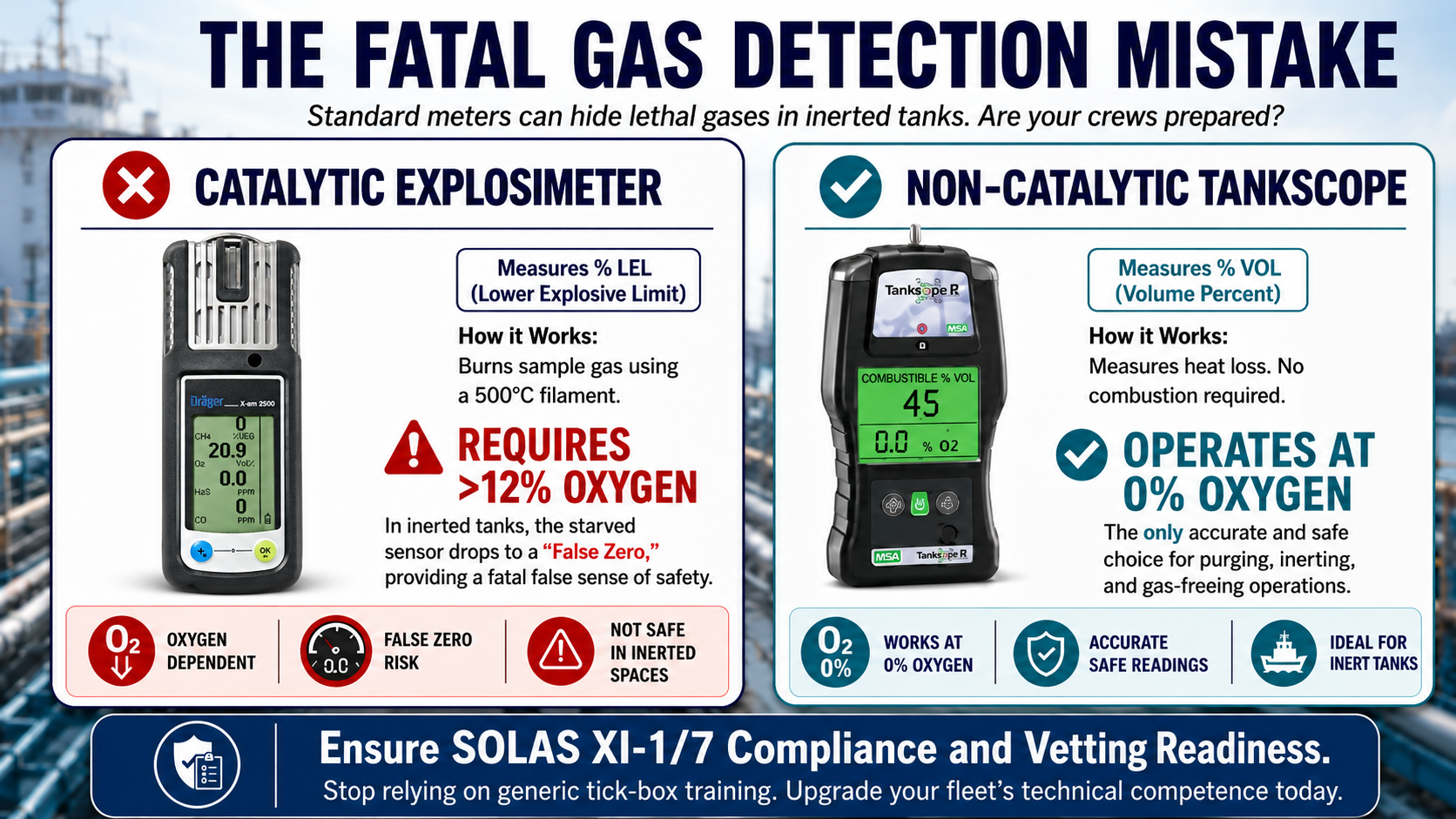
It utilises a thermal oxidation principle where an internal filament heats to 500⁰ C to oxidise incoming hydrocarbon gases. This chemical combustion alters the filament’s electrical resistance to calculate the percentage of the Lower Explosive Limit (% LEL).
The Fatal Constraint: 
Because the sensor relies on actual combustion inside the device, it requires an environment containing at least 12% oxygen by volume to function correctly.
The Danger:
If a seafarer introduces a catalytic explosimeter into an inerted cargo tank—where oxygen has been displaced by nitrogen or carbon dioxide—the device cannot support combustion. The reading may drop back to zero, potentially providing a false and fatal indication of safety when the atmosphere is actually saturated with explosive hydrocarbons.

EXPLOSIMETER VS TANKSCOPE AT A GLANCE

The Solution for Inerted Spaces: The Tankscope

When monitoring atmospheres lacking sufficient oxygen—such as during purging, inerting, or gas-freeing operations—mariners must deploy a Tankscope (Non-catalytic Heated Filament Gas Indicator).

Unlike the explosimeter, a Tankscope does not burn the gas; it measures gas volume percentage directly by monitoring heat loss from a hot filament. Operating via a balanced Wheatstone Bridge circuit, it compares a sensor filament exposed to the sample gas against a balancing filament kept in clean air. Because non-catalytic filaments do not rely on oxygen, high gas concentrations will not damage the sensor; the pointer simply stays beyond the scale until it encounters a leaner mixture.

Protecting Your Sensors: "Poisons" and Inhibitors


To maintain accurate safety metrics, crews must actively manage substances that degrade gas detector performance:
1

Toxic Substances (Poisons):

Compounds like organic lead and silicone vapours permanently degrade catalytic pellistor performance.
2

Inhibitors:

Substances such as Hydrogen Sulphide, freon gases, and chlorinated hydrocarbons temporarily reduce sensor sensitivity. If Hydrogen Sulphide is suspected, the crew must test for it specifically using chemical indicator tubes before measuring hydrocarbons to safeguard sensor integrity.


Frequently asked questions

Can Emergency Escape Breathing Devices (EEBDs) be used for enclosed space entry or rescue operations?

Absolutely not. According to international safety regulations and standard shipboard procedures, the use of EEBDs for entry into enclosed spaces is strictly prohibited. EEBDs are engineered for escape purposes only, providing a short duration of air strictly for evacuating a compromised space. Any entry for operations or rescue requires a Self-Contained Breathing Apparatus (SCBA).

Why do chemical tube detectors require special positional awareness during toxic gas sampling?

When sampling highly toxic gases like Benzene or Hydrogen Sulphide using chemical tube detectors, the operator must always stand on the windward side and as far from the vent as possible. Standing just one metre away from the vent stream reduces the operator's personal toxic exposure by up to 90%.

Safety is a Continuous Journey, Not a Coincidence

For individuals

Are you ready for your next vetting inspection?

Master LEL thresholds, sensor mechanics, and gas-freeing operations at your own pace. Upgrade your competency and earn your certificate online.
Write your awesome label here.

For Corporate


Do your officers know the limits of their testing gear?

Stop relying on generic "tick-box" e-learning. Protect your seafarers, minimise operational risks, and satisfy international vetting standards (in accordance with IMO Res. MSC.581(110)) with Maritime Trainer's specialized corporate solutions.